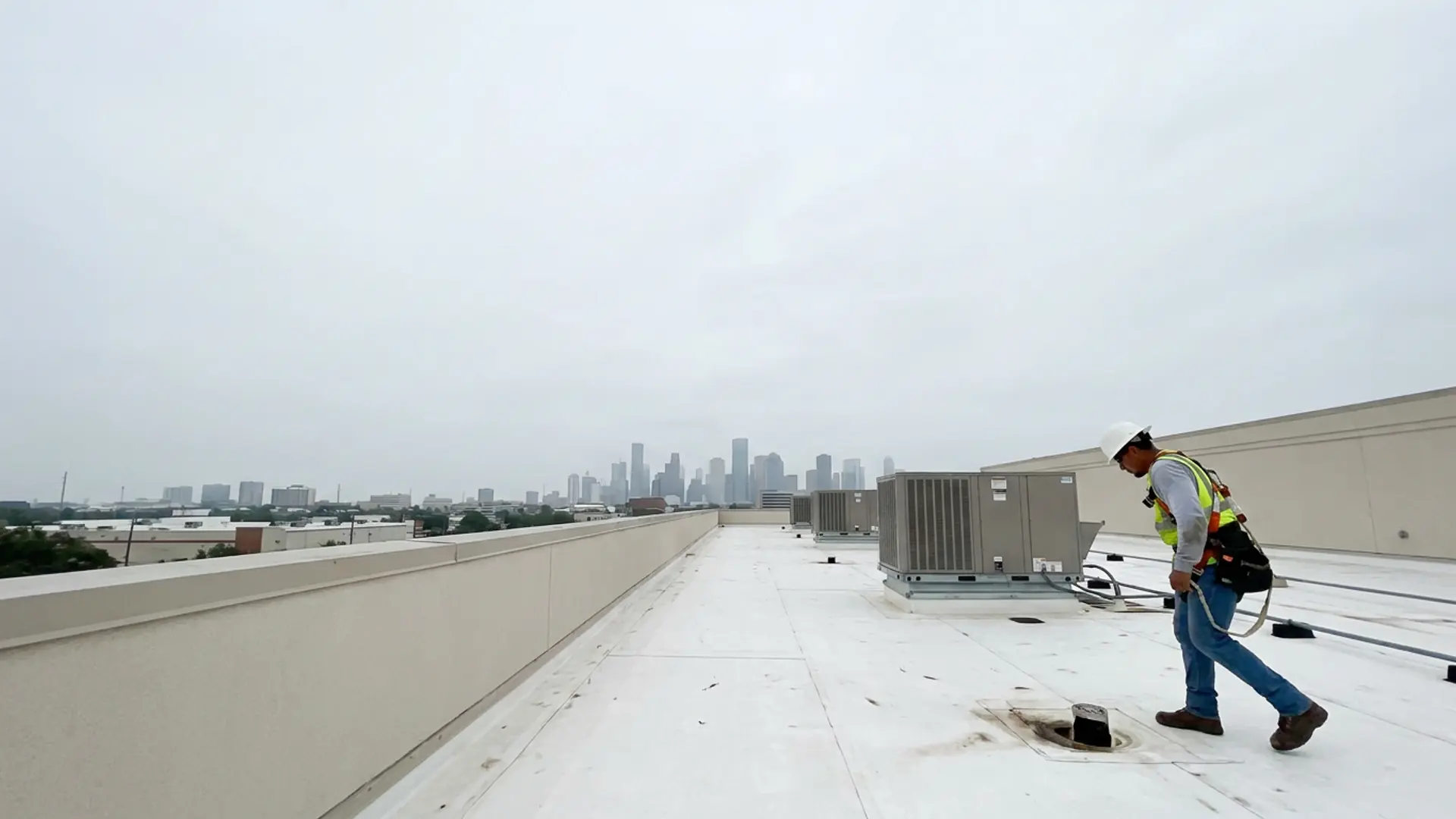
Houston, TX & the surrounding area
Commercial Roof Inspection in Houston
Roof Inspection Houston connects Houston property owners and managers with one insured local roofing professional for commercial roof inspection, and the first thing worth saying is that this is a different job from the residential one. A commercial roof inspection in Houston deals with low-slope membrane and built-up systems, where water sits rather than runs and the failures are at seams, terminations, and drains. Free connection, no obligation to hire.
- Free roof inspection
- Insured local pro
- No obligation
Free Roof Inspection
No-cost inspection, no obligation to hire
Insured Local Roof Inspectors
Get an inspection from an insured local roofing professional
Real Answers
Get real answers before you approve a repair or file a claim
Property managers with a portfolio and a maintenance budget to defend. Facility managers who need a condition record before a capital request. Building owners weighing repair against replacement. Buyers doing due diligence on a commercial property. Anyone whose insurer, lender, or board has asked for documentation of roof condition.
The common thread is that the decision is rarely urgent and almost always has to be justified to somebody else. That is why documentation matters more here than it does on a house. If the portfolio is scattered single-family homes rather than an office, warehouse, retail building, or other low-slope commercial asset, rental property roof inspection is the more useful path.
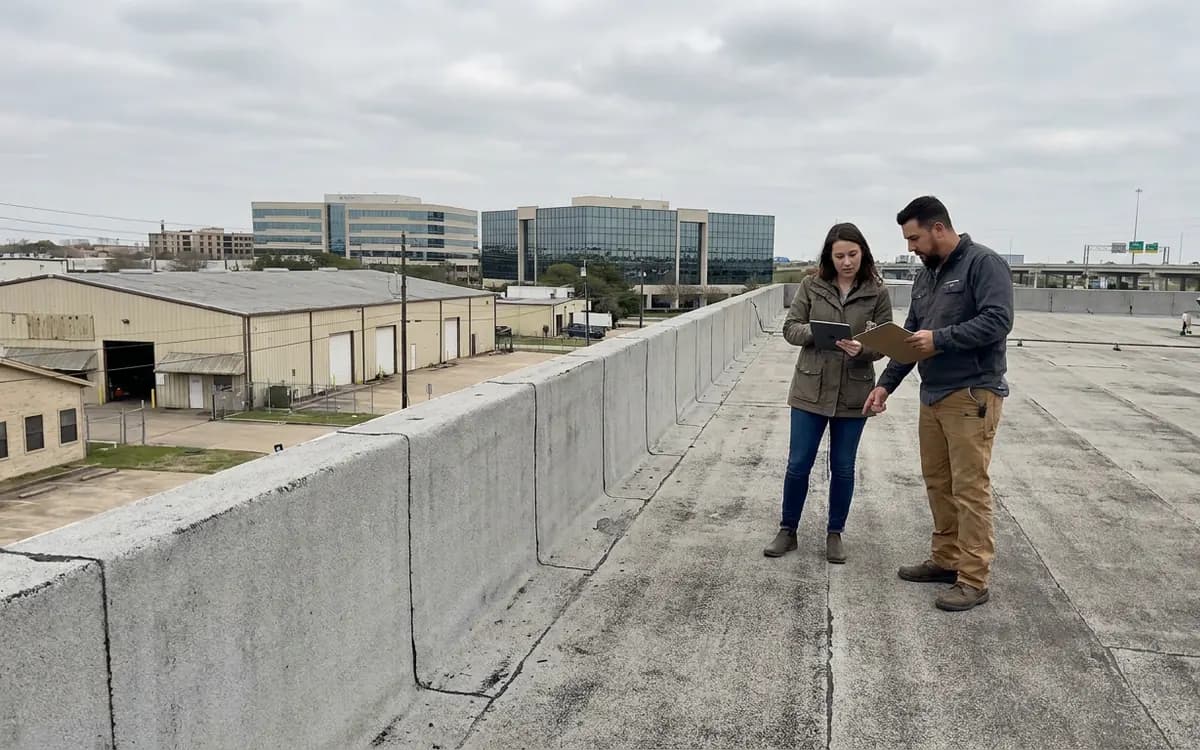
What a Houston Commercial Roof Inspection Checks
A residential roof sheds water. A commercial low-slope roof manages it, and that distinction drives everything the inspection looks at.
Seams and laps. On single-ply systems the field membrane is rarely the problem. The seams between sheets are, and so are the details where the membrane is welded or adhered around anything that penetrates it.
Terminations and flashings. Where the membrane meets a parapet, a curb, an expansion joint, or a wall. Base flashing pulling away at a parapet is one of the most common findings on any Houston low-slope roof.
Penetrations. HVAC curbs, exhaust fans, vent stacks, conduit, gas lines, satellite mounts. Every one is a hole in the roof that something is supposed to be sealing, and every one is a place a maintenance contractor may have stepped, drilled, or improvised.
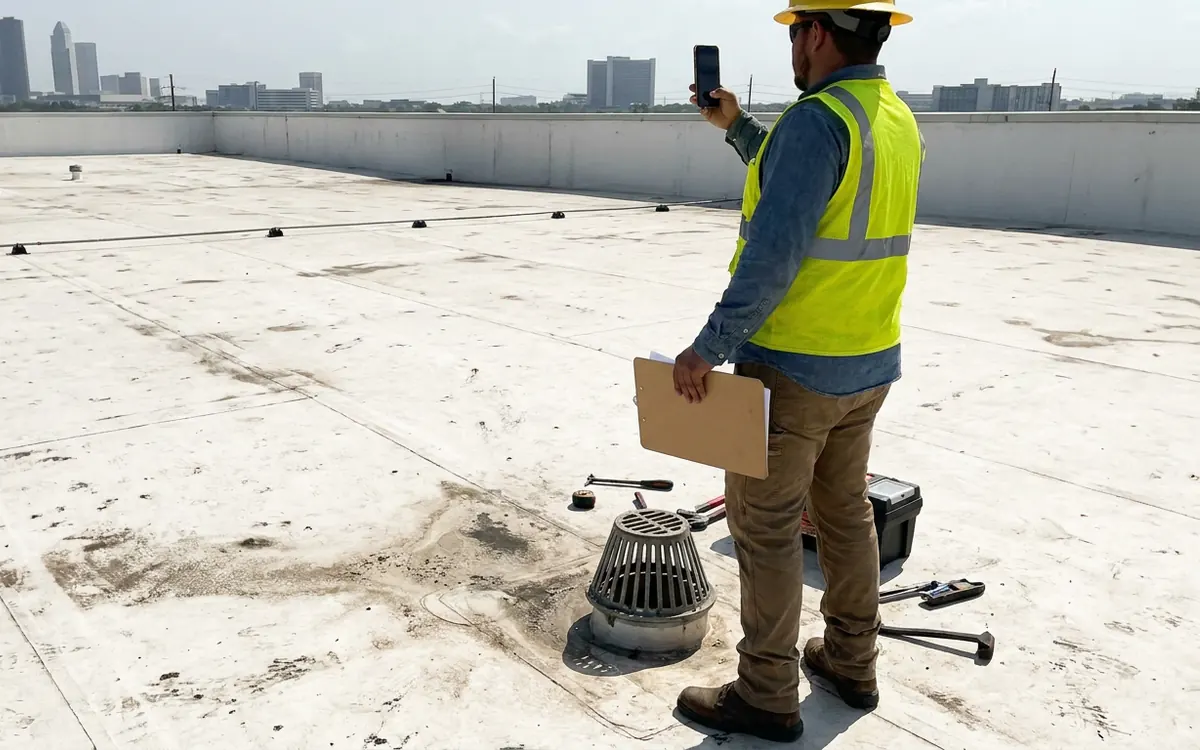
Drains, scuppers, and ponding. Blocked drains are among the most preventable commercial roof problems in this city. Standing water adds structural load, accelerates membrane degradation, and hides the defect underneath it. Water still sitting on a roof more than a couple of days after rain is a finding in its own right.
Surface and substrate condition. Blistering, splitting, shrinkage at corners on older single-ply, alligatoring on built-up, granule loss on cap sheets, and soft spots underfoot that indicate saturated insulation below the membrane.
If hail or wind is the trigger for the visit, the storm damage roof inspection page explains the separate documentation and insurance boundary.
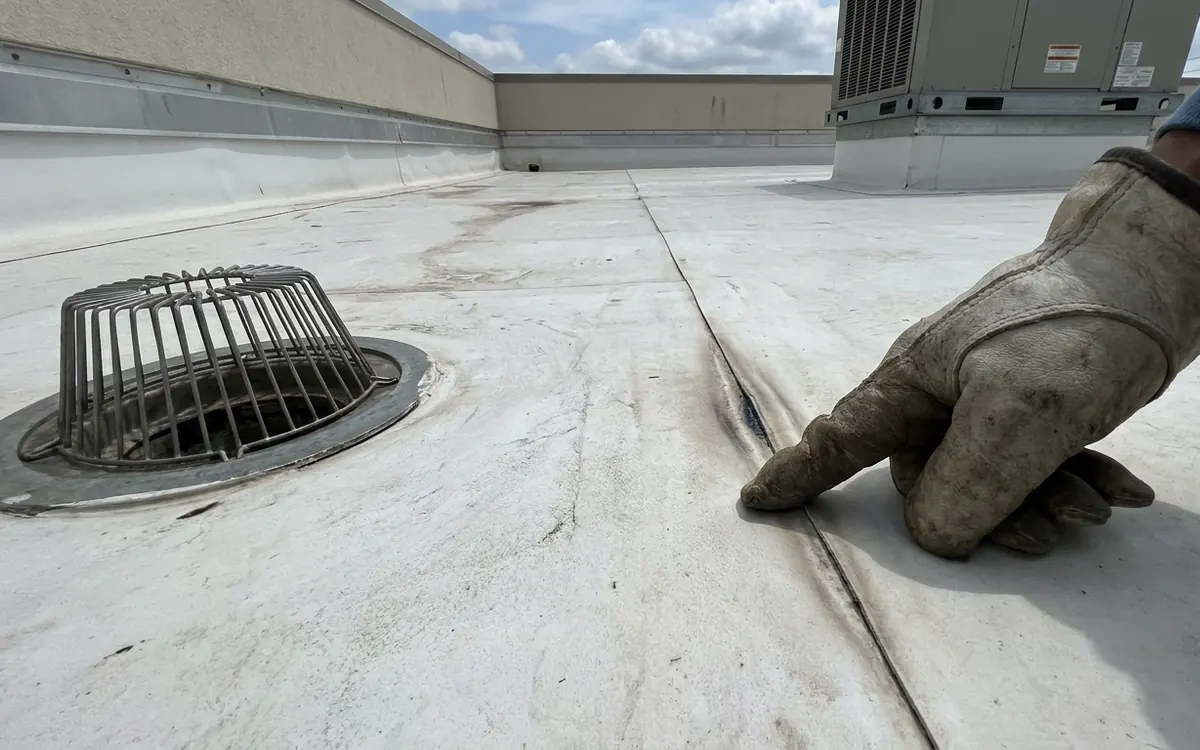
Commercial Roof Systems: TPO, EPDM, Modified Bitumen, BUR & Metal
Knowing which system is on your building changes what you should expect to hear.
TPO — thermoplastic polyolefin, a heat-welded single-ply, usually light-colored and reflective. Common on newer construction. Failures concentrate at weld seams and at the terminations.
EPDM — a synthetic rubber single-ply, typically dark, either ballasted, mechanically fastened, or fully adhered. Durable in the field; the seams and the flashing details are where age shows.
Modified bitumen — asphalt-based sheets in multiple plies, torch-applied, hot-mopped, or self-adhered. Failures show at laps and at the base flashings.
Built-up roofing (BUR) — the traditional multi-ply asphalt-and-felt system with a gravel or cap-sheet surface. Long-lived when maintained, and when it fails it usually does so at the flashings and at aged surfacing.
Metal panel — failures at fasteners, at panel seams, and at penetration curbs rather than across the panel itself.
A useful survey also notes the insulation and cover board condition below the membrane, since saturated insulation is frequently the real cost driver in a replacement, and any infrared or moisture survey findings where that method was used to map wet areas without cutting the roof open.
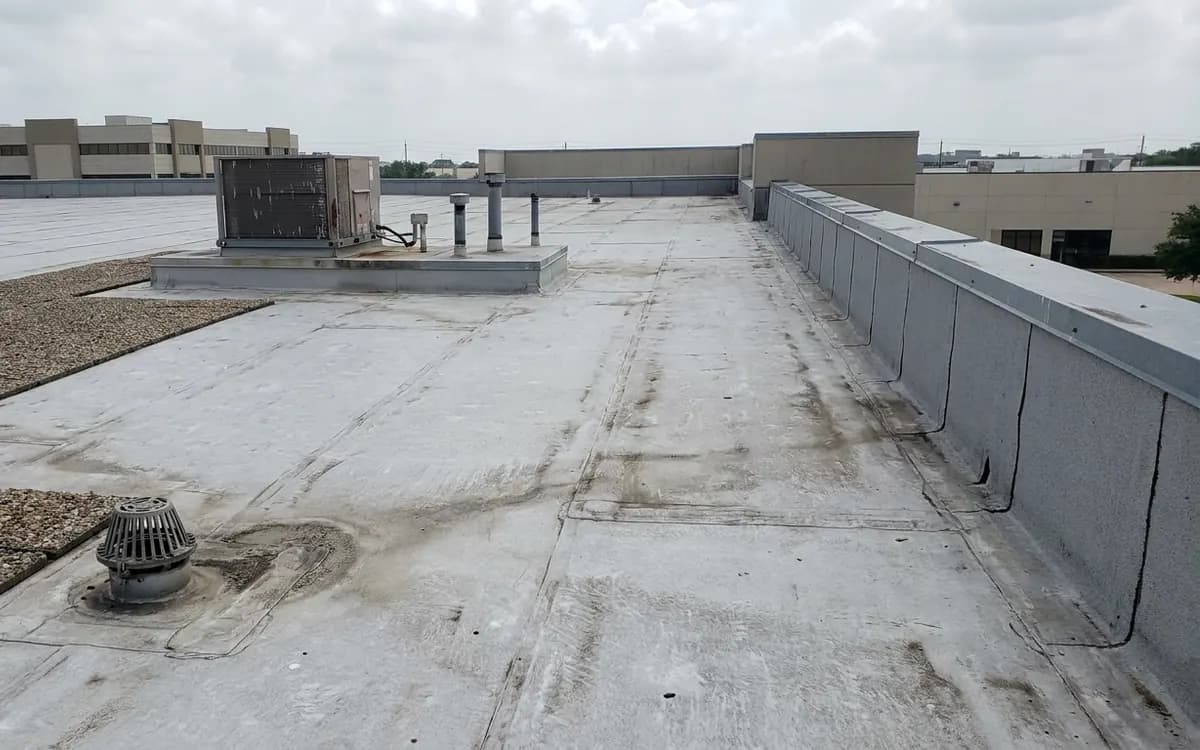
What a Commercial Roof Inspection Report Should Include
On a house the deliverable is usually an answer. On a commercial building it is a record.
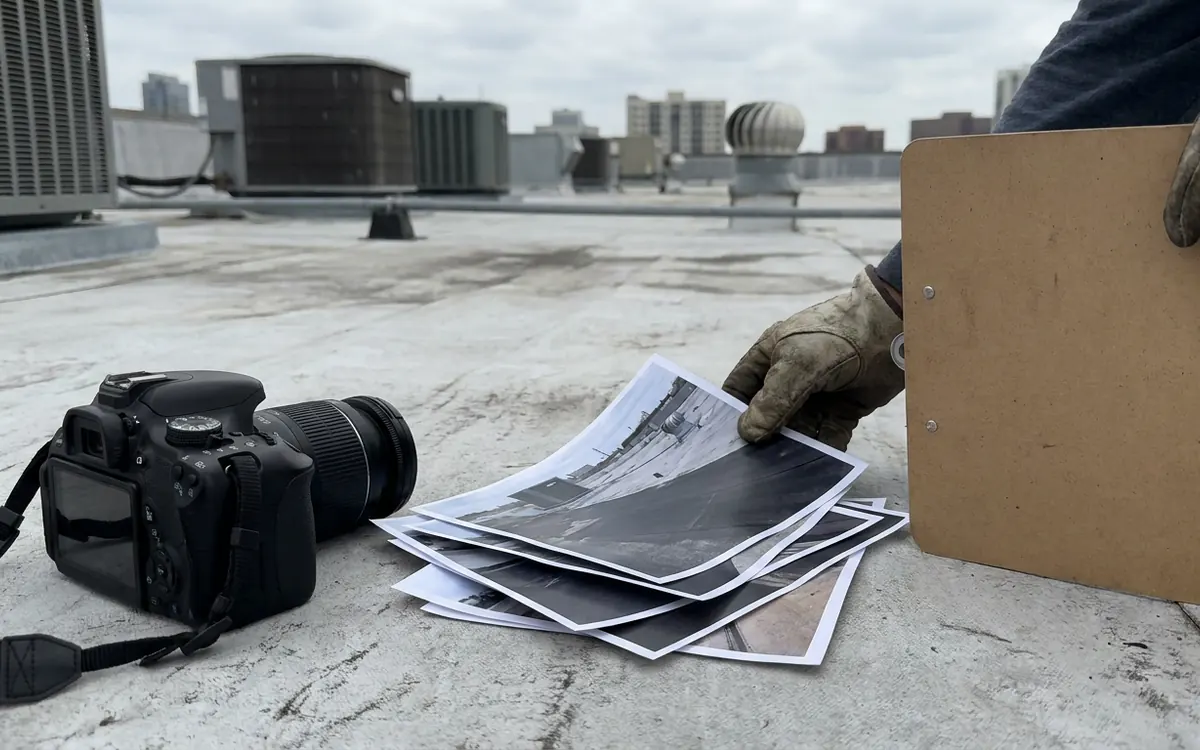
A useful commercial inspection produces a written condition summary, photographs keyed to locations on the roof, findings separated into immediate leaks, active deterioration, and deferred maintenance, and an indication of remaining service life. That is what a capital request, a board packet, an insurance file, or a due-diligence review can actually be built on.
Two things are worth confirming before the visit rather than after. First, whether a formal written report is included or is a separate paid deliverable — it is frequently the latter, and assuming otherwise costs you a second appointment. Second, whether your manufacturer warranty requires documented periodic inspection to stay in force. Requirements vary by warranty, and a lapse in the maintenance record can complicate a later warranty request. Check the actual document. The inspection-frequency guide explains the commercial timing question separately from Houston's residential rhythm.
Commercial Roof Inspection Cost in Houston: Free Survey vs. Paid Report
The connection we arrange is free, and for a straightforward condition walk on an accessible low-slope roof that is usually all it costs. Commercial pricing diverges from residential as soon as the deliverable becomes formal, and it is worth understanding what drives the number before you ask for a quote.
Free contractor survey. $0. A roofing professional walks the roof, identifies condition and any active leaks, and discusses the next step. Appropriate for a leak, a post-storm check, or an owner who wants to know where the roof stands.
Paid condition survey with written report. This is the deliverable many property managers actually need, and it is a separate paid service rather than an automatic upgrade to the free visit. Price tracks square footage first, then access, roof complexity, and how many penetrations and details have to be individually documented.
For the residential side of the free-versus-paid question, the roof inspection cost guide covers it in detail.
Infrared Moisture Surveys, Core Sampling & Commercial Cost Drivers
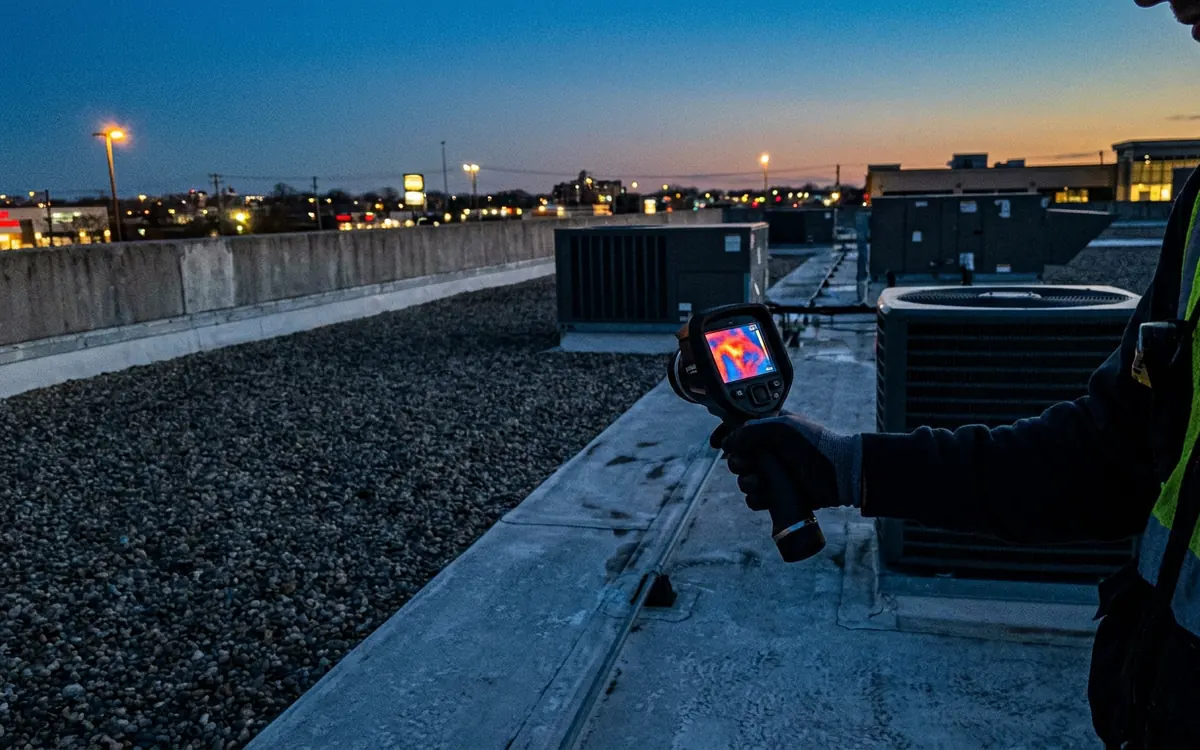
Infrared or moisture survey. A meaningful step up in cost, because it is a different method with different equipment, often performed after sundown when the thermal differential is readable. It maps possible wet areas below the membrane without cutting the roof open, which is what makes it useful when the question is how much of the roof may be wet — a question a visual survey cannot answer by itself.
Core sampling. Physically cutting and patching small test areas to confirm the assembly and the number of existing layers. It is normally scoped as part of a replacement assessment or due-diligence review rather than a routine inspection.
These are specialist paid scopes. Confirm that the roofing professional offers the method, what the deliverable includes, and the price before the visit. The drone roof inspection guide explains where aerial and infrared tools genuinely help and where an in-person inspection still has to take over.
Three things move a commercial number more than anything else. Square footage, because the survey is a systematic walk rather than a look. Access, because a roof reached by hatch is a different job from one requiring a lift or fall-protection rigging. And documentation depth, because a photograph keyed to a roof plan with a written finding against it takes time that a verbal summary does not.
Get the scope agreed in writing before the visit. The most common way this goes wrong is a manager who assumes the report is included, discovers it is not, and pays for a second mobilization to get the document the lender asked for.
What Roof Inspection Houston Does—and Does Not Do
We are a referral service. We connect you with one independent insured local roofing professional. We do not perform inspections, we do not produce reports, we do not administer warranties, and we are not the contractor.
Verify the contractor's insurance, their experience with your specific roof system, and the written scope before authorizing anything. Commercial roofing is specialized by system — a company excellent on shingles is not automatically the right one for a 60,000 square foot TPO roof.
What to Have Ready for a Commercial Roof Inspection
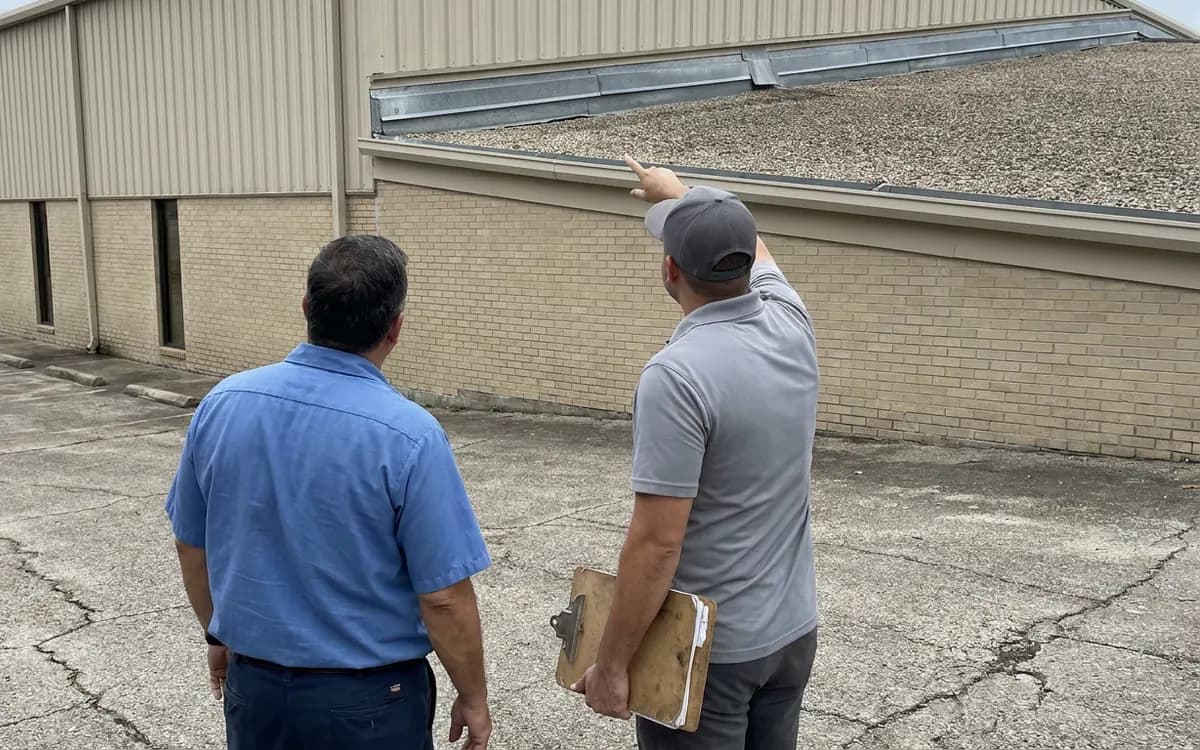
Have the building type and approximate square footage, roof system if you know it, roof age, active-leak details, roof-access arrangements, and whether you need a formal written report. Those details let the local professional confirm the scope before attending instead of discovering at the hatch that the equipment or deliverable is wrong for the job.
Tell us your municipality and ZIP as well. The service areas page covers the normal Houston-area route, but the roofing professional confirms availability for the specific building.
Questions
Frequently Asked Questions
How often should a commercial roof be inspected?
Common practice is twice a year, usually before and after the storm season, plus an additional visit after any significant weather event. Many manufacturer warranties on single-ply systems also require documented periodic inspection and maintenance to remain valid — check what your specific warranty requires.
What is the difference between a commercial and a residential roof inspection?
The roof systems differ, so the inspection differs. Low-slope commercial roofs are membrane or built-up systems where the failure points are seams, terminations, flashings, and drainage rather than individual shingles. Ponding water, blocked drains, and open seams have no real residential equivalent.
Can an inspection be done without disrupting the tenants or the business?
Usually. Most of a low-slope roof survey happens on the roof itself with access through a hatch or exterior ladder. Interior access is only needed where there is evidence of water entry to trace. Schedule access and any tenant notice with the contractor in advance.
Do you provide the formal roof condition report our lender or insurer wants?
We are a referral service and do not perform inspections or produce reports ourselves. Tell us up front that a formal written report is what you need — that is a specific paid deliverable and it should be agreed in scope with the contractor before the visit, not assumed.
Ready to get started?
Ready for a free inspection? Get connected with a local, insured roofing professional. Straight answers, clear scope, and no obligation to hire.